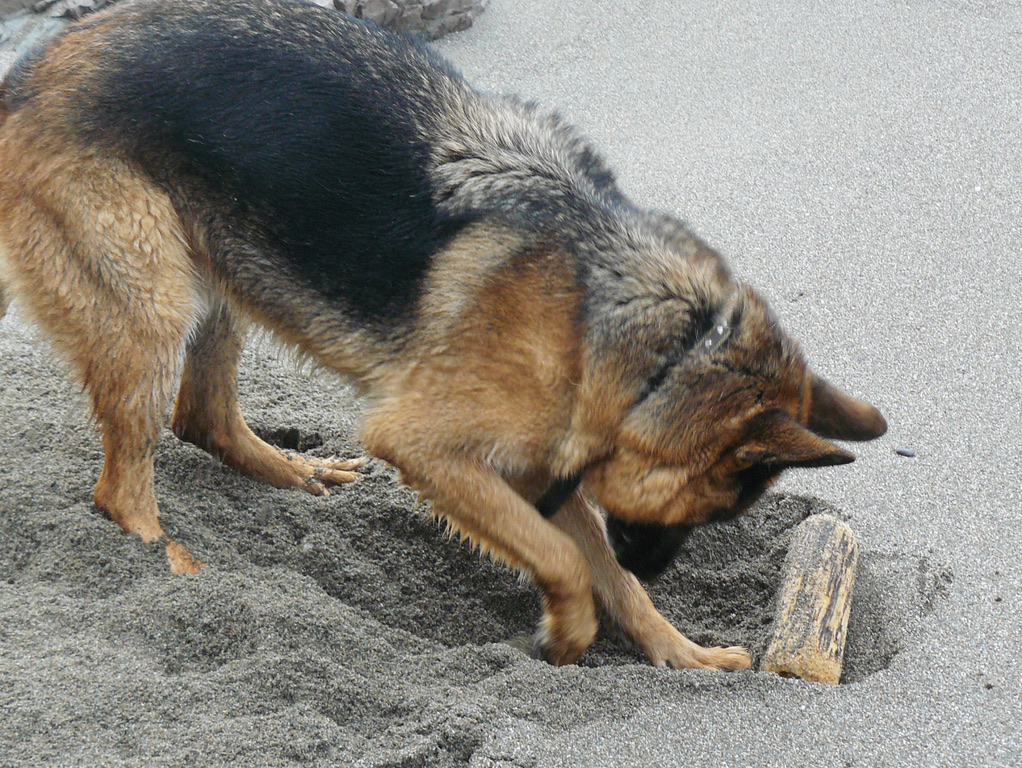
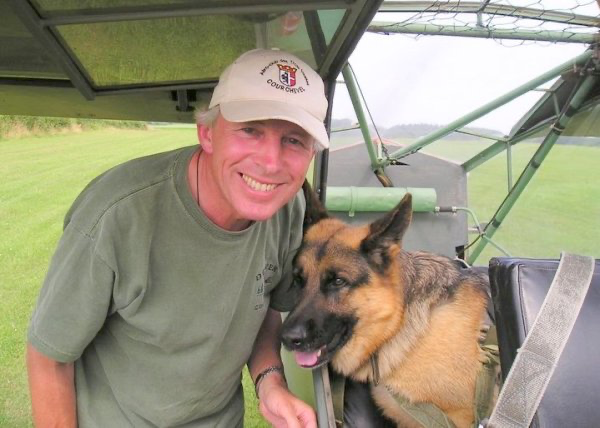
Beloved Pharaoh. Born: June 3rd., 2003 – Died: June 19th., 2017. A very special dog that will never be forgotten.
Dogs live in the present – they just are! Dogs make the best of each moment uncluttered by the sorts of complex fears and feelings that we humans have. They don’t judge, they simply take the world around them at face value. Yet they have been part of man’s world for an unimaginable time, at least 30,000 years. That makes the domesticated dog the longest animal companion to man, by far!
As man’s companion, protector and helper, history suggests that dogs were critically important in man achieving success as a hunter-gatherer. Dogs ‘teaching’ man to be so successful a hunter enabled evolution, some 20,000 years later, to farming, thence the long journey to modern man. But in the last, say 100 years, that farming spirit has become corrupted to the point where we see the planet’s plant and mineral resources as infinite. Mankind is close to the edge of extinction, literally and spiritually.
Dogs know better, much better! Time again for man to learn from dogs!
In early April 2026, the Artemis II mission captivated me and millions of people watching from across the world. The crew’s courage, skill and infectious wonder served as tangible proof of human persistence and technological achievement, all against the mysterious backdrop of space.
People back on Earth got to witness the mission through remarkable photos of space captured by astronauts. Images created and shared by astronauts underscore how photography builds a powerful, authentic connection that goes beyond what technology alone can capture.
As a photographer and the director of the Rochester Institute of Technology’s School of Photographic Arts and Sciences, I am especially drawn to how these photographs have been at the center of the public’s collective experience of this mission.
In an era when image authenticity is often questioned and with the capabilities of autonomous, AI-driven imaging, NASA’s choice to train astronauts in photography has placed meaning over convenience and prioritized their human perspectives and creativity.
Capturing space from the crew’s perspective
Photography was not originally placed as a high priority in NASA’s Apollo era. The astronauts only took photographs if they had the chance and all their other tasks were complete.
‘The Blue Marble’ view of the Earth as seen by the Apollo 17 crew in 1972. NASA
This excitement could be explained by the novelty of photos from space, but these images also distinguish themselves as products of astronauts experiencing these sights and interpreting them through their photographs. These differences require an important distinction around where technology ends and humanity begins.
NASA astronaut Reid Wiseman watches the Moon from one of the Orion spacecraft’s windows. NASA
Human perspective versus AI tools
Photography has long integrated AI-powered software and data-driven tools in a variety of ways: to process raw images, fill in missing color information, drive precise focus and guide image editing, among others. These modern technological assists help human photographers realize their vision.
And AI can generate convincing, realistic images and videos from nothing more than a text prompt, using readily available tools.
Researchers train AI to mimic patterns informed by millions of sample images, and the algorithm can then either take or create a photograph based on what it predicts would be the most likely version of a successful, believable image.
Human-created photos are rooted in direct observation, intent and lived experience, while AI images – or choices made by AI-driven tools – are not. While both can produce compelling and believable visuals, the human photographs carry emotional power because the photographer is drawing from their experiences and perspective in that moment to tell an authentic story.
Artemis II photographs resonate, not only because they are historic, but because they reflect the deliberate choices and intent of a human being in that specific moment and context. The exposure, camera setting, lens choice and composition are all dictated by the astronaut’s vision, skill, perspective and experience. Each image is unique in comparison with the others. These choices give the images narrative power, anchoring them in human perspective.
NASA’s ‘Earthset’ photo captured by the Artemis II crew. NASA
Images to tell a story
Photographers choose what to include in the final version of their image to tell a story. In the Artemis II images, this human perspective comes out. In the “Earthset” photo, you see a striking juxtaposition of the Moon’s monochromatic, textured surface in the foreground against a slivered, bright Earth.
The choice to include both in the frame contrasts these objects literally and figuratively, inviting comparison. It creates a narrative where Earth is contrasted against the Moon – life is contrasted against the absence of it.
Another photo shows the nightside of the whole Earth, featuring the Sun’s halo, auroras and city lights. The choice to include the subtle framing of the window of the capsule in the lower left corner reminds the viewer where and how this image was captured: by a human, inside a capsule, hurtling through space. That detail grounds the photograph in the human perspective.
Both photos are reminiscent of Earthrise and the Blue Marble. These past images hold a place in the global collective consciousness, shaped by a shared historical moment.
The Artemis II photographs are anchored in this collective moment of lived human experience, yet also shaped by each astronaut’s viewpoint. The crew’s unique perspectives exemplify photography’s transformative power by inviting viewers to engage emotionally and intellectually with their journey. These photographs share the astronauts’ awe and wonder and affirm the value of human creativity and its ability to connect us in a captured moment.
I am going to repeat a sentence towards the end of the article: “These past images hold a place in the global collective consciousness, shaped by a shared historical moment.”
Amazingly, Jean and I were being run recently in to somewhere local and Trevor, our driver, was listening to a talk by David Eagleman. I was captivated.
In that talk David Eagleman spoke about Roger Penrose and his research into consciousness. Here’s an AI summary:
Roger Penrose proposes that human consciousness is non-computational and originates from quantum processes within brain neurons, rather than just neural connections. Together with anesthesiologist Stuart Hameroff, he developed the “Orchestrated Objective Reduction” (Orch OR) theory, which suggests consciousness arises from quantum computations in microtubules.
Roger Penrose is the author of The Emperers New Mind.
Thus, beyond the eighty-six billion neurons that make up the brain, there are also the microtubals. These are very small and the diameter of several thousand of them are less than the diameter of the human hair. See WikiPedia.
“The brain has deep purpose” was one of the sayings Eagleman spoke of. “Why do we have experience” was another.
There was much more that I did not really understand. But it was still fascinating.
Then we discovered that what Trevor was listening to was also a video. The video is Inner Cosmos. It runs for 75 wonderful minutes.
Here is that video.
To say that this has absolutely updated my mind to a newer level is an understatement; big time!
Jean and I were taken to our regular humanist meeting last Saturday morning. The topic was Christian Nationalism.
Today, I want to explain what these commitments are. Then on Sunday I will post some images.
ooOOoo
Ten Commitments
Guiding Principles for Teaching Values in America’s Public Schools
Altruism
Altruism is the unselfish concern for the welfare of others without expectation of reward, recognition, or return. Opportunities for acts of altruism are everywhere in the family, the classroom, the school, and the wider community. Think of examples of altruistic acts in your experience. What person-to-person and group projects, classroom and school-wide activities, and community service projects might you and your students undertake?
Caring for the World Around Us
Everyone can and ought to play a role in caring for the Earth and its inhabitants. We can directly experience the living things in our homes and neighborhoods like trees, flowers, birds, insects, and pets. Gradually we expand our neighborhood. We learn about deserts and oceans, rivers and forests, the wildlife around us and the wildlife elsewhere. We learn that we are dependent on each other, on the natural world, and all that lives in it for food and shelter, space and beauty.
Critical Thinking
We gain reliable knowledge because we are able to observe, report, experiment, and analyze what goes on around us. We also learn to raise questions that are clear and precise, to gather information, and to reason about the information we receive in a way that tests it for truthfulness, accuracy, and utility. From our earliest years we learn how to think and to share and challenge our ideas and the ideas of others, and consider their consequences. Practice asking “what next?” and “why?” and “how do I/you/we know that?”
Empathy
We human beings are capable of empathy, the ability to understand and enter imaginatively into another living being’s feelings, the sad ones and the happy ones as well. Many of the personal relationships we have (in the family, among friends, between diverse individuals, and amid other living things) are made positive through empathy. With discussion and role-playing, we can learn how other people feel when they are sad or hurt or ignored, as well as when they experience great joys. We can use stories, anecdotes, and classroom events to help us nurture sensitivity to how our actions impact others.
Ethical Development
Questions of fairness, cooperation, and sharing are among the first moral issues we encounter in our ethical development as human beings. Ethical education is ongoing implicitly and explicitly in what is called the “hidden curriculum” that we experience through the media, the family, and the community. Ethics can be taught through discussion, role-playing, storytelling, and other activities that improve analysis and decision-making regarding what’s good and bad, right and wrong.
Global Awareness
We live in a world that is rich in cultural, social, and individual diversity, a world where interdependence is increasing rapidly so that events anywhere are more likely to have consequences everywhere. Much can be done to prepare the next generation for accepting the responsibility of global citizenship. Understanding can be gained regarding the many communities in which we live through history, anthropology, and biology. A linguistic, ethnic, and cultural diversity are present in the classroom and provide lessons of diversity and commonality. We help others reach understanding about the interconnectedness of the welfare of all humanity.
Humility
We must always remember that there’s a lot we don’t know about the universe. There’s still so very much to learn. Science will help us. But sometimes scientists discover surprising things that tell us how some of our old beliefs are false. So we need to be willing to change when our knowledge changes. A good humanist doesn’t try to be sure of things that science can’t show are true.
Peace and Social Justice
A curriculum that values and fosters peace education would promote the human rights of all people and understanding among all nations, cultural and religious groups. Students should have opportunities to learn about the United Nations’ role in preventing conflict as well as efforts to achieve social justice in the United States. They should learn about problems of injustice including what can be done to prevent and respond to these problems with meaningful actions that promote peace and social justice and that protect the inherent human rights of everyone both at home and abroad.
Responsibility
Our behavior is morally responsible when we tell the truth, help someone in trouble, and live up to promises we’ve made. Our behavior is legally responsible when we obey a just law and meet the requirements of membership or citizenship. But we also have a larger responsibility to be a caring member of our family, our community, and our world. Stories and role-playing can help students understand responsibility and its absence or failure. We learn from answering such questions as: What happens when we live in accordance with fair and just rules? What happens when we don’t? What happens when the rules are unjust?
Service and Participation
Life’s fulfillment can emerge from an individual’s participation in the service of humane ideals. School-based service-learning combines community service objectives and learning objectives with the intent that the activities change both the recipient and the provider. It provides students with the ability to identify important issues in real-life situations. Through these efforts we learn that each of us can help meet the needs of others and of ourselves. Through our lifetime, we learn over and over again of our mutual dependence.
ooOOoo
My mother was an atheist and, consequently, I have been an atheist all my life. With the above values, as they are taught in schools, there is no need for a God.
“Join me on an unforgettable 36 hour adventure to Sal, a hidden gem in Cape Verde, where the stunning beaches and unique wildlife make it a bird photography paradise.
With its incredible array of shorebirds, kestrels, and ospreys, Sal is a must-visit destination for any wildlife enthusiast or bird photography aficionado.
In this video, I’ll be sharing my experiences and tips on how to capture the perfect shot, from low angle bird photography to using the right equipment, such as the OM System OM1, to get up close and personal with these amazing creatures.
Whether you’re a seasoned wildlife photographer or just starting out, this 36 hour challenge will provide valuable insights into the world of travel wildlife photography and the techniques used to photograph birds abroad.
From the beautiful landscapes of Cape Verde to the thrilling experience of photographing birds in their natural habitat, this video is a must-watch for anyone passionate about nature photography, birding, and wildlife conservation. With its unique blend of stunning scenery, fascinating wildlife, and expert photography tips, this video is sure to inspire and educate, so sit back, relax, and enjoy the journey to Sal, a true bird photography paradise in the heart of Cape Verde., in the Cape Verde islands, is known as a winter sun destination—but is it any good for wildlife photography?”
Watch along and get some Wildlife Photography Travel Tips and How to photograph shorebirds.
📸 Camera Gear: OM System OM-1mkII OM system 150-400 TC pro DJI Osmo Pocket 3 DJI mic 3
Winter is more than just a season in the western U.S. – it is a savings account to get farms and homes through the long, dry summer ahead. As the snowpack that accumulates in the mountains through winter slowly melts in late spring and summer, it feeds into rivers and reservoirs that keep communities and ecosystems functioning.
The April 1 snowpack measurement has long been the single most important number in western water management, considered a strong proxy for how much water the mountains are holding in reserve.
Across the western United States, temperatures from November through February were among the warmest on record, with many areas 5 to 10 degrees Fahrenheit (2.8 to 5.5 degrees Celsius) above the 20th-century average. March continued to break heat records. At lower elevations, the higher temperatures meant a significant part of the winter’s precipitation fell as rain rather than snow. In some places, snowfall accumulated but melted quickly during warm periods.
The total area of the western U.S. with snow cover was exceptionally low compared with the rest of the 21st century. National Snow and Ice Data Center
As a result, even regions that received near- or above-normal precipitation for the season failed to build substantial snowpack. In the northern Rockies and the mountains of the Pacific Northwest, any above-average snow accumulation was largely confined to the highest elevations, while middle and lower elevations had relatively little snowpack.
This situation is a hallmark of warming winters. As global temperatures rise, the freezing line where precipitation changes from rain to snow moves up the mountains, shrinking the area capable of sustaining a seasonal snowpack.
At the vast majority of the U.S. Natural Resources Conservation Service’s snow measurement stations across the West, the snowpack’s snow-water equivalent on March 30, 2026, was less than 50% of the 1991-2020 median. Natural Resources Conservation Service
The exceptionally warm winter of 2025–26 across much of the western U.S. delivered a powerful preview of what the regional water cycle in a warmer climate may increasingly look like: less snow and a fundamental reshaping of the hydrograph – the chart of how much water flows through streams across the year.
A flattening hydrologic pulse
The consequences of this shift for water supplies are already visible in streamflows.
In multiple river basins in the West, streamflows were above average in winter and early spring, and some locations were approaching record-high levels. Historically, that water would have remained frozen in the snowpack until late spring. Instead, precipitation arriving as rain – along with intermittent midwinter melting events – increased the runoff.
Scientists who study natural water flows, as I do, pay attention to the hydrographs of streamflows in river basins to see when the water flow in mountain streams is strongest and how long that flow is likely to continue into summer.
This hydrograph showing two years of water flows in the St. Mary River near Babb, Mont., reflects the difference between a typical late-spring peak, as 2025 saw, and several midwinter peaks from warm temperatures and rain, as 2026 is seeing. U.S. Geological Survey
In recent years, rising temperatures have led to a redistribution of streamflows throughout the winter and early spring in ways that are fundamentally reshaping the hydrographs of snowmelt-dominated rivers. Rather than a single dominant peak during late spring or early summer, smaller peaks emerge in winter and early spring. At the same time, the traditional snowmelt pulse, relied on to fill reservoirs in late spring, weakens.
In effect, the hydrograph is flattening. The winter of 2025–26 illustrates this phenomenon: Higher early-season streamflows suggest the West will see less runoff later in the year when communities, farms and wildlife need it.
The Colorado River: A system on the edge
Nowhere does the convergence of record warmth, depleted snowpack and altered hydrology carry higher stakes than in the Colorado River Basin. More than 40 million people in seven states plus Mexico and 5.5 million acres of farmland depend on the river’s water, but the river’s flow is no longer meeting demand.
The April-through-July 2026 runoff into Lake Powell – the reservoir behind Glen Canyon Dam and the primary index of the Upper Colorado River Basin’s annual water budget – is currently forecast to rank among the lowest in recent decades. It has been tracking close to the grim years of 2002 and 2021, considered benchmarks of western drought.
Unless spring brings substantial late-season snowfall to the high mountains, 2026 could join those years as a marker of how thin the margin between water supply and demand has become in a river system already under sustained stress from two decades of drought and water overuse.
The low reservoir levels in the basin in 2026 and the low snowpack are adding fears of water shortages just as the seven states that rely on the Colorado River are struggling to reach a new water use agreement.
The changing rhythm of water in the West
The winter of 2025–26 highlights two emerging realities.
First, temperature is increasingly dominating precipitation in determining western water supplies. Even above-normal precipitation cannot compensate for persistent warmth when it falls as rain rather than snow and accelerates snowmelt in the mountains.
Second, the nature of the West’s streamflows is shifting in ways that complicate water management.
Rain-on-snow events can produce flooding in winter, as the Seattle area saw in late December 2025. A low snowpack also means less runoff in summer, which can exacerbate water shortages and raise the wildfire risk as landscapes dry out. Even if a year has normal precipitation, if it falls as rain or there is earlier snowmelt, then evaporation through summer, in a warmer climate, will leave less water in the system.
Snowpack declines, earlier runoff, elevated winter flows and flattened hydrographs are all consistent with long-standing projections for the western United States as global temperatures rise.
What makes the winter of 2025-26 notable is how clearly these signals appeared, even in a year without widespread precipitation deficits.
This shift highlights the need for adaptive reservoir operations – the ability to adjust water storage and release decisions in real time to capture earlier runoff and preserve water for longer dry seasons, while still maintaining space in reservoirs for flood control during wetter winters. For communities across the West, it also reinforces the growing reality that the familiar seasonal rhythm of mountain water is changing.
This past January, a man was walking through Onancock, Virginia, when he noticed a suspicious object outside Historic Onancock School, a local community center.
The man approached the object — a large black bin labeled “Family Dollar” — and carefully lifted the lid to see what was inside. There, wriggling against each other in the tight space, were eight 10-week-old puppies.
The puppies were weak, defenseless and clearly needed help. The man drilled air holes in the lid of the box and eventually contacted Eastern Shore Regional Animal Control Facility for help.
Tragically, one puppy passed away before rescuers could assist. The others quickly relaxed into the capable hands of animal control staff.
According to Eastern Shore Regional Animal Control Facility shelter manager Jeri Winn, it’s common to find puppies dumped along the Eastern Shore, but significantly less common in Onancock, a bustling seaside town.
Though she’d seen plenty of cases like this, Winn still felt a familiar sadness as she admitted the puppies into care. Despite everything, she was grateful that the pups were finally in a safe place.
“All we can be thankful for [is that] whoever left them realized they were in a good location to be seen,” Winn told The Dodo.
Team members transferred the puppies to Critters 4 U Rescue, an animal shelter and foster organization. Rescuers determined the puppies were Australian shepherd mixes, and they named them after the seven dwarfs — Doc, Grumpy, Happy, Sleepy, Bashful, Sneezy and Dopey.
One pup has already been adopted, and the others are still safe at Critters 4 U Rescue, waiting to meet their forever families.
Eastern Shore Regional Animal Control Facility is grateful for Critters 4 U Rescue, along with all the other rescues who offered to help these needy pups find the homes they deserve.
“We are so grateful for every rescue that reached out,” Eastern Shore Regional Animal Control Facility wrote in a Facebook post. “In moments like this, our small shelter is reminded just how much we rely on the compassion and partnership of rescue organizations who step up without hesitation.”